

Poland has become an increasingly popular destination for people looking to invest in their long-term health. In this article, 4 Best Longevity Clinics in Poland, you'll discover clinics that combine advanced diagnostics, biomarker testing, and personalized health planning to help identify potential risks before they become larger concerns. This preventive approach is based on the Medicine 3.0 longevity model, which focuses on improving long-term health and performance rather than simply treating illness.

One of Poland's key advantages is that it offers structured longevity programs at a lower cost than many clinics in Western Europe or the U.S. However, affordability is only part of the decision. The right clinic is the one that fits your health goals, lifestyle, and expectations. Before comparing your options, it's helpful to understand what longevity medicine is and how it supports a more proactive approach to healthy aging.
1. Longevity Center Poland: Measurement-Led Model
Longevity Center Poland is a preventive health clinic that focuses on comprehensive diagnostics and long-term health monitoring. Its approach centers on assessing key biomarkers, biological age, and individual health risks to create a clear baseline before developing personalized strategies for ongoing health optimization.
Focus: Baseline diagnostics and long-term tracking
- Structured 4–5 hour assessment covering cardiovascular, metabolic, and cognitive markers
- Emphasis on biological age testing and risk profiling
- Follow-up programs extending up to 12 months
Interpretation:
This model aligns with a data-first approach, where understanding precedes intervention. It is often used as an entry point into longevity medicine.
|
|
Explore Longevity Center (Warsaw)

2. VIMED Medical Longevity Clinic Poland: Intervention-Led Model
VIMED Medical Longevity Clinic Poland is a preventive longevity clinic that focuses on correcting underlying health imbalances linked to aging and long-term wellness. Using its Phenotype Therapy® approach, the clinic combines advanced metabolic testing with therapies such as hyperbaric oxygen therapy (HBOT) to create personalized programs that support metabolic health, reduce chronic inflammation, and improve overall resilience.
Focus: Chronic inflammation and metabolic correction
- Uses Phenotype Therapy® to tailor treatment
- Incorporates hyperbaric oxygen therapy (HBOT) and advanced metabolic testing
- Targets inflammation and immune resilience as central drivers of aging and long-term health.
Interpretation:
This model assumes that active correction of underlying dysfunction is necessary, rather than observation alone.
|
|
Explore VIMED Medical Longevity Clinic

3. Klinika Długowieczności Poland: Precision Medicine Model
Klinika Długowieczności Poland is a precision medicine clinic that uses genetic testing and advanced diagnostics to assess individual health risks. Through Whole Exome Sequencing (WES), nutritional analysis, and metabolic pathway evaluations, the clinic aims to support personalized prevention strategies and identify potential health concerns at an early stage.
Focus: Genetics and individualized risk mapping
- Whole Exome Sequencing (WES)
- Nutritional and metabolic pathway analysis
- Early detection of rare or complex conditions
Interpretation:
This reflects the genomics-driven direction of longevity science, though practical applications are still evolving.
|
|
Explore Klinika Długowieczności (Krakow)

4. NAMI Klinika, Sopot, Poland: System-Level Recovery Model
NAMI Klinika Sopot, Poland, is a longevity and recovery clinic that focuses on restoring overall health through a system-wide approach. Its multi-day residential programs combine medical care with sleep optimization, metabolic reset, and nervous system support to improve recovery, resilience, and long-term well-being.
Focus: Stress, recovery, and environmental factors
- Multi-day residential programs
- Integration of medical care with environmental exposure
- Focus on sleep, metabolic reset, and nervous system regulation to improve sleep and recovery patterns.
Interpretation:
This model treats longevity as a system-wide balance, not just a clinical measurement.
|
|
Explore NAMI Klinika i Resort Medyczny

How to Evaluate Longevity Clinics as an Executive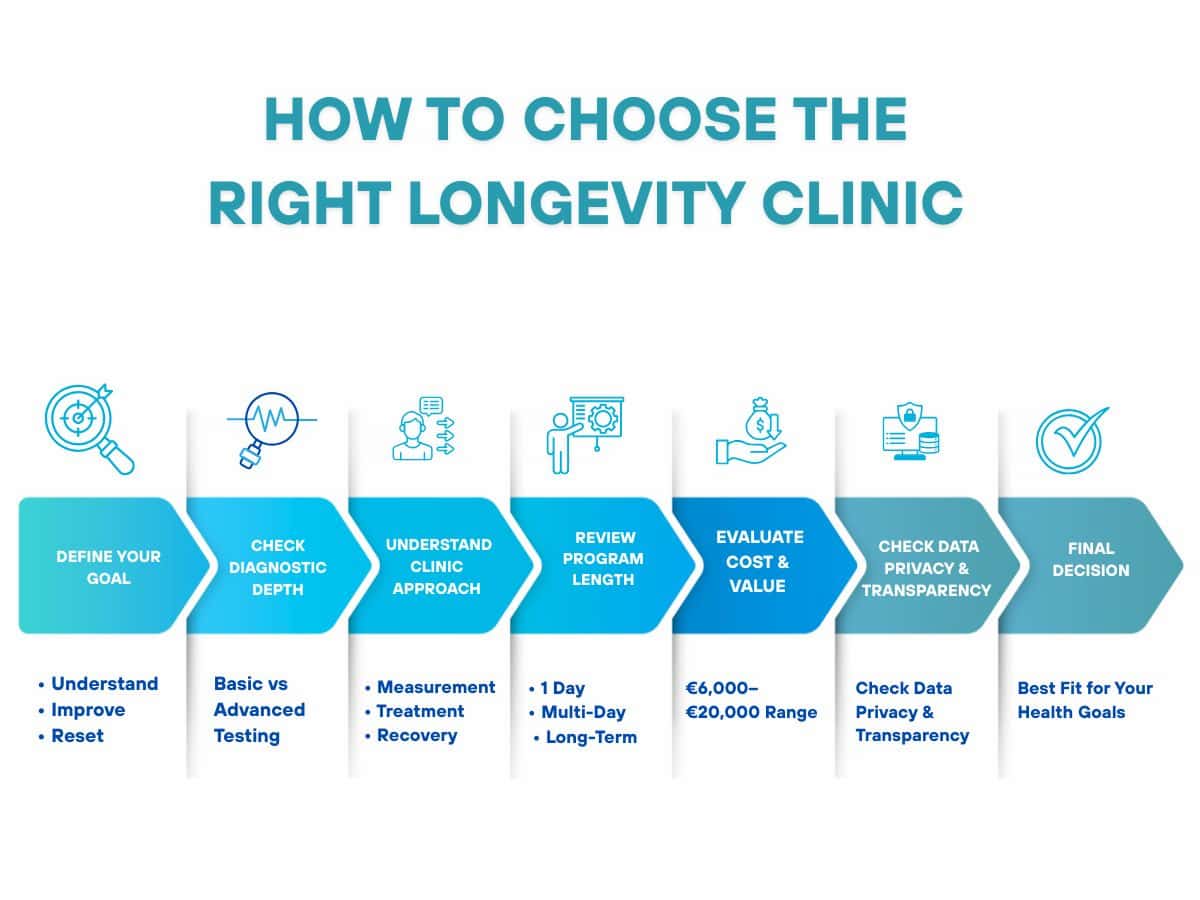
Evaluation is less about comparing features and more about understanding decision fit. This aligns with broader discussions around why traditional approaches such as diet and exercise alone may stop delivering results over time. To bridge this gap, many professionals are now turning to structured solutions like executive health check for longevity, which go beyond basic check-ups by focusing on deep diagnostics, long-term tracking, and performance-based health planning helping individuals move from guesswork to clear, data-driven decisions.
Key Evaluation Criteria
1. Depth of Diagnostics
- Are biomarkers limited or comprehensive?
- Does the clinic measure biological age, inflammation, and metabolic health?
2. Model Transparency
- Is the approach clearly explained?
- Are methodologies evidence-aligned or proprietary without clarity?
3. Time Structure
- One-day assessment vs multi-week engagement
- Ongoing tracking vs one-time reporting
4. Data Handling
- How is sensitive health data stored and used?
- Are there clear privacy protocols?
Quick Comparison Table
|
|
|
|
|
|
|
|
|
|
|
|
|
|
|
|
|
|
|
|
|
|
|
|
Costs and Practical Considerations
Cost is often the first visible difference when comparing Poland to other longevity markets. However, pricing alone does not explain value.
Cost of Longevity Clinics in Poland
The cost of longevity clinics in Poland typically ranges from €6,000 to €20,000, depending on diagnostic depth, program duration, and level of intervention.
Cost Structure Overview
- Initial assessments: typically €6,000–€8,000
- Extended programs: can range up to €20,000 depending on scope
These costs reflect access to diagnostics, specialist time, and program design not guaranteed outcomes.
What Drives Cost Differences
1. Diagnostic Depth
More advanced testing (genomics, multi-omics, imaging) increases cost and complexity.
2. Program Duration
One-day assessments differ significantly from multi-month managed programs.
3. Intervention Layer
Clinics offering therapies (e.g., metabolic correction, oxygen therapy) typically operate at higher price tiers.
|
|
Travel and Logistics for International Patients
For international clients, Poland is operationally straightforward. The complexity lies less in travel and more in timing and coordination with clinic schedules.
Entry Points
- Warsaw (WAW) – primary hub for Longevity Center and VIMED
- Krakow (KRK) – access to precision medicine clinics
- Gdańsk (GDN) – closest to Sopot (NAMI clinic)
🔗 Find the best flights to Poland (Warsaw, Krakow, Gdansk)
🔗 Find car rentals in Poland
Internal Movement
- High-speed trains connect major cities efficiently
- Private transfers are commonly arranged by clinics
- Car rentals are practical when combining multiple locations
Accommodation Context
- Warsaw and Krakow: business hotels, serviced apartments
- Sopot: resort-style stays aligned with recovery programs
Accommodation choice often depends on clinic proximity and program duration, not tourism preference.
🔗 Explore nearby hotels & apartments
|
|
Choosing The Best Longevity Clinic In Poland
Before selecting a clinic, the more useful question is not “Which is best?” but
“What role do I want longevity medicine to play in my life?”
Three Practical Starting Points
1. Clarity Without Commitment
- Focus on diagnostics and understanding risk
- Lower ongoing engagement
2. Active Correction
- Focus on improving the measurable decline
- Requires time and follow-through
3. System Reset
- Focus on stress, recovery, and sustainability
- Often requires stepping away from routine temporarily
|
|
How Poland Fits Into the Longevity Landscape
Poland occupies a specific position in the global longevity ecosystem.
It is not the most advanced in experimental research, nor the most established in premium concierge care. Instead, it offers a structured, accessible entry point into longevity medicine, combining clinical depth with operational efficiency.
Positioning Snapshot
|
|
|
|
|
|
|
|
|
|
|
|
|
|
|
|
|
|
This positioning explains why Poland is gaining attention not as a default choice, but as a practical option within a broader decision set.
What It Offers
- Access to advanced diagnostics and biomarker tracking
- Structured programs aligned with preventive health models
- Faster access compared to more saturated healthcare systems
What It Does Not Fully Resolve
- Lack of standardized protocols across clinics
- Variability in methodology and depth
- Ongoing uncertainty in long-term outcome measurement
|
|
Frequently Asked Questions
Are longevity clinics in Poland comparable to those in Switzerland or the U.S.?
They can be comparable in diagnostic capability, particularly in well-established clinics. However, differences often exist in research integration, experimental therapies, and concierge-level service. Poland tends to emphasize structured, evidence-aligned programs rather than frontier innovation.
How should biological age testing be interpreted?
Biological age is best understood as a directional metric, not an absolute measure. It reflects patterns in biomarkers and physiological systems. Different clinics may use different methods, which can lead to variation in results.
Is there strong scientific consensus behind longevity medicine?
There is growing support for core principles such as inflammation control, metabolic health, and early risk detection. However, many interventions—especially those claiming age reversal are still under investigation. The field combines established science with emerging hypotheses.
Why are executives increasingly considering longevity clinics?
The shift is often linked to long-term performance management. High-responsibility roles place sustained demands on cognitive and physical systems. Longevity medicine offers a structured way to monitor and manage those demands over time.
How do longevity clinics differ from executive health check-ups?
Traditional executive health check-ups are typically snapshot-based assessments. Longevity clinics aim to build continuous health models, tracking change over time and identifying patterns rather than isolated results.
Are outcomes from longevity programs measurable?
Some aspects, such as metabolic markers or inflammation levels, can be tracked and compared over time. However, broader outcomes like extended healthspan or delayed disease onset are more complex and require long-term observation.
What are the best longevity clinics in Poland?
The best longevity clinics in Poland vary depending on the model used some focus on diagnostics, others on intervention or recovery. The most suitable option depends on whether the priority is measurement, correction, or system-level reset.
Final Thoughts
Longevity clinics in Poland reflect a growing shift from treating illness after it appears to managing health proactively. Instead of focusing only on disease, these clinics emphasize early risk detection, personalized diagnostics, and long-term health planning. For many professionals, longevity medicine is less about extending lifespan and more about maintaining energy, performance, and overall well-being over time.
Choosing a longevity clinic is not about finding a universal 'best' option. It's about selecting an approach that matches your health goals, comfort with preventive interventions, and long-term priorities. Poland offers a range of evidence-informed longevity programs, making it a practical choice for those seeking greater insight into their health through structured, preventive care.
↩ Return to ExtendMy.Life
Disclaimer
This article is provided for informational and analytical purposes only. It is designed to help readers understand the structure, positioning, and considerations around longevity clinics in Poland within a broader decision-making context.
It does not constitute medical advice, diagnosis, or treatment recommendation.
Longevity medicine is an evolving and interdisciplinary field that combines elements of preventive care, biomarker analysis, genomics, and emerging therapeutic approaches. While many concepts discussed—such as inflammation, metabolic health, and biological age—are supported by scientific research, clinical applications, methodologies, and outcomes are not yet fully standardized across providers or regions.
Any references to clinics, technologies, or interventions are included for contextual understanding only and should not be interpreted as endorsements, guarantees, or recommendations.
Readers should be aware that:
- Individual health conditions, risks, and responses vary significantly
- Not all longevity interventions are universally validated or regulated
- Data such as biological age or biomarker profiles are interpretive tools, not definitive diagnoses
- Privacy considerations may apply when sharing genetic or health data with third-party providers
Before making any health-related decisions, readers are strongly encouraged to consult with qualified, licensed healthcare professionals and, where appropriate, seek independent medical opinions.
ExtendMyLife does not provide clinical services and does not assume responsibility for decisions made based on this content.
References
Bonnes, S.L.R., Strauss, T., Palmer, A.K., Hurt, R.T., Island, L., Goshen, A., Wang, L.Y.T., Kirkland, J.L., Bischof, E. and Maier, A.B. (2024) ‘Establishing healthy longevity clinics in publicly funded hospitals’, GeroScience, 46, pp. 4217–4223.
Chaudhari, P.S. and Ermolaeva, M.A. (2024) ‘Too old for healthy aging? Exploring age limits of longevity treatments’, npj Metabolic Health and Disease, 2, article 37.
Demaria, M. (2025) ‘Longevity clinics: between promise and peril’, Aging, 17(10), pp. 2452–2454.
Herzog, C.M.S., Poganik, J.R., Boekstein, N., Fortney, K., Peyer, J.G., Mellon, J., Starr, R., Barzilai, N. and Moqri, M. (2025) ‘Recommendations for biomarker data collection in clinical trials by longevity biotechnology companies’, npj Aging, 12, article 16.
Li, X., Ploner, A., Wang, Y., Zhan, Y., Pedersen, N.L., Magnusson, P.K., Jylhävä, J. and Hägg, S. (2021) ‘Clinical biomarkers and associations with healthspan and lifespan: Evidence from observational and genetic data’, EBioMedicine, 66, article 103318.
Mironov, S., Borysova, O., Morgunov, I., Zhou, Z. and Moskalev, A. (2024) ‘A framework for an effective healthy longevity clinic’, Aging and Disease, 16(4), pp. 1971–1986.
Nielsen, J.L., Bakula, D. and Scheibye-Knudsen, M. (2022) ‘Clinical trials targeting aging’, Frontiers in Aging, 3, article 820215.
Organisation for Economic Co-operation and Development (OECD) (2026) Poland: Health and demographic indicators. Paris: OECD Publishing.
Polish Society of Longevity Medicine (PTMD) (2025) Polish Society of Longevity Medicine: Organisational overview and research initiatives. Warsaw: PTMD.
Statistics Poland (GUS) (2025) Healthy Life Years in Poland 2024. Warsaw: Statistics Poland.
CorAeon (2025) CorAeon: Functional concierge medicine and longevity care model. Caldwell, NJ: CorAeon.
Longevity Center (2026) Longevity Center Poland: Clinical model and services overview. Warsaw: Longevity Center.
NAMI Klinika i Resort Medyczny (2026) Medical longevity programs and integrated care model. Sopot: INVICTA Group.
VIMED Medical Longevity Clinic (2025) Phenotype Therapy® and functional longevity medicine approach. Warsaw: VIMED MLC.
Klinika Długowieczności (2026) Precision medicine and longevity diagnostics services. Krakow: Klinika Długowieczności.
Note on References
These sources include peer-reviewed research, institutional publications, and clinical documentation. They reflect the current state of longevity science and its application in clinical settings, which continues to evolve.
Discover More Longevity Clinics