Concierge Medicine Europe was established under the leadership of Dr. Jana Yanova, with a focus on building a structured, prevention-oriented clinical system.
The clinic functions as a multidisciplinary medical hub, where more than 30 specialists including cardiology, physiotherapy, nutrition, and general medicine operate within a coordinated framework. This reduces fragmentation commonly seen in traditional healthcare systems.
A defining operational feature is the clinic’s diagnostic-first workflow, where assessment precedes any intervention. One example is the 6-hour Manager Check-up, which consolidates multiple specialist evaluations into a single structured visit. This includes laboratory testing, imaging, and physician consultations within one session.
From an operational perspective, CME prioritizes:
- Time efficiency for high-performing individuals
- Direct coordination (bypassing call centres)
- Structured data collection followed by physician interpretation
This model aligns with broader findings that concierge and direct-care systems can reduce delays in access and improve continuity, although long-term outcome data remains limited (Leive, David and Candon, 2023; ScienceDirect, 2023).
At a Glance – Concierge Medicine Europe
|
Category
|
Details
|
|
Location
|
Prague, Czech Republic
|
|
Clinic Type
|
Physician-led concierge longevity clinic
|
|
Core Focus
|
Preventive medicine, early risk detection, lifestyle medicine
|
|
Typical Stay
|
Same-day structured diagnostics (e.g., 6-hour check-up)
|
|
Diagnostic Depth
|
Multisystem evaluation with advanced diagnostics
|
|
Signature Method
|
Manager Check-up (multi-specialist assessment in one visit)
|
|
Environment
|
Urban clinical facility (Parkview building)
|
|
Privacy Level
|
High – limited patient panel and direct coordination
|
|
Professional Recognition
|
Referenced in Forbes, Vogue, Expats.cz
|
Many individuals integrate clinic visits into existing business travel rather than scheduling extended stays. The central Prague location supports short, structured appointments without requiring downtime, which is often a key factor for executives.
This clinic is also featured among the best longevity clinics in Prague, known for its personalised and preventive healthcare approach.
Concierge Medicine Europe is selected primarily for its structural differences in care delivery, rather than for individual therapies or experiences.
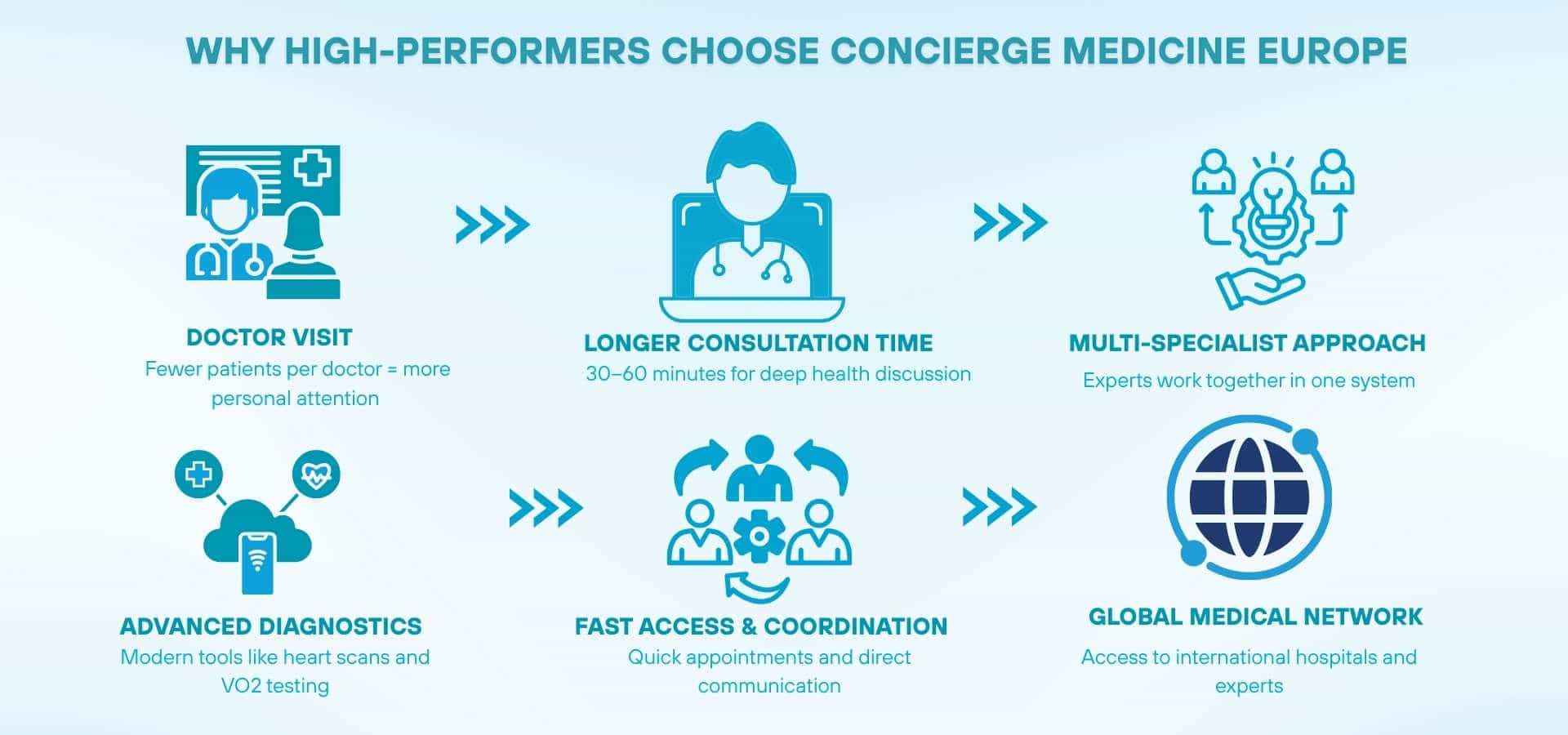
Key Differentiators
1. Limited Patient Load
Each physician manages approximately 650 patients, compared to over 2,500 in conventional systems. This enables:
- Continuity of care
- Faster access
- Deeper case familiarity
Lower patient-to-physician ratios are associated with improved patient engagement and satisfaction in concierge models (Alhawshani and Khan, 2024).
2. Extended Consultation Time
Appointments typically last 30–60 minutes, compared to 10–15 minutes in standard care settings.
This allows:
- Detailed medical history analysis
- Lifestyle and behavioural review
- Structured long-term planning
Longer consultations have been linked to improved adherence and patient understanding, although evidence remains context-dependent (Journal of Family Medicine and Primary Care, 2024).
3. Integrated Multidisciplinary System
Over 30 specialists operate within a single coordinated environment, reducing fragmentation across services.
This supports:
- Centralized diagnostics
- Cross-specialist collaboration
- More consistent interpretation of results
4. Named Diagnostic Technologies
CME uses specific, measurable diagnostic tools rather than generalized assessments, including:
- 3D echocardiography for cardiovascular structure and function
- CPET (VO2 max testing) for metabolic and performance capacity
- AI-assisted dermatological screening for early skin risk detection
- Genetic screening for predisposition analysis
These technologies are used to identify risk patterns early, not to predict outcomes with certainty.
5. Structured Access and Coordination
Patients receive:
- Same-day or next-day access for urgent concerns
- Direct communication with a medical coordinator
- Elimination of traditional gatekeeping systems
This reduces system friction and waiting time, which is a known limitation in conventional healthcare systems (OECD, 2026).
6. International Medical Network Access
For complex cases, the clinic coordinates second opinions from:
- Leading hospitals in the United States
- European institutions such as Wiener Privatklinik
This adds a layer of global medical validation, particularly for high-stakes decision-making.
Concierge Medicine Europe operates under a preventive framework often referred to as Medicine 3.0. This model shifts focus from treating disease after onset (reactive care) to identifying and managing risk factors before clinical symptoms appear.
This aligns with the Medicine 3.0 approach, which focuses on proactive, data-driven healthcare.
In traditional systems (sometimes described as Medicine 2.0), care is typically triggered by symptoms. In contrast, CME emphasizes:
- Early biomarker detection
- Continuous monitoring
- Physician-led interpretation of longitudinal data
This approach aligns with broader preventive healthcare models, which aim to reduce disease burden through early intervention and lifestyle modification (OECD, 2026).
Importantly, CME does not rely on trends or unvalidated interventions. Instead, it focuses on clinically measurable inputs such as:
- Cardiovascular markers
- Metabolic performance
- Sleep and stress indicators
The role of the physician is central. Data alone does not guide decisions interpretation within clinical context remains critical.
Core System Focus
The clinic primarily focuses on cardiovascular and metabolic systems, as these are strongly linked to long-term health outcomes and performance capacity.
This includes:
- Cardiovascular risk profiling
- Metabolic efficiency and energy utilization
- Body composition and physical performance
|
🔍 Did You Know?
Large-scale studies show that maintaining key lifestyle factors healthy weight, physical activity, and diet can extend life expectancy by over a decade at age 50 (Li et al., 2018). This reinforces the importance of early detection and structured lifestyle intervention.
|
Lifestyle as a Medical Tool
Lifestyle is treated as a clinical variable, not a general recommendation.
The clinic integrates:
- Nutrition planning
- Physical activity tracking
- Sleep evaluation
- Stress management
Chronic stress, especially after 35, can significantly impact long-term biological health.
These are not handled as isolated habits but as interconnected systems influencing risk pathways.
|
🔍 Did You Know?
Preventive lifestyle interventions have been associated with reduced incidence of chronic diseases such as diabetes and cardiovascular conditions, although outcomes depend on adherence and individual variability (PubMed Central, 2024).
|
The clinic’s approach is to structure these variables into measurable, trackable plans, reviewed under physician supervision.

CME follows a diagnostics-first workflow, meaning all clinical decisions begin with structured assessment rather than assumptions or symptom-based treatment.
The goal is to build a multi-system health profile, identifying early-stage risks across cardiovascular, metabolic, and neurological domains.
Diagnostic Assessment Includes
The clinic uses a combination of laboratory testing, imaging, and performance diagnostics, including:
- 3D Echocardiography
Used to assess cardiac structure and function in detail
- CPET (VO2 Max Testing)
Measures oxygen utilization and cardiovascular performance
- Advanced Blood Panels
Includes metabolic, hormonal, and inflammatory markers
- Genetic Screening
Identifies predispositions to certain conditions
- AI-Assisted Skin Analysis
Supports early dermatological risk identification
- Body Composition Analysis
Evaluates fat, muscle, and metabolic indicators
- Sleep Diagnostics (Sleep Lab)
Assesses sleep quality and potential disorders
These tools allow for early identification of deviations from baseline health, rather than waiting for disease manifestation.
Understanding the difference between biological vs chronological age helps provide deeper insight into long-term health and aging.
|
🔍 Did You Know?
Advanced diagnostics can identify subclinical disease states conditions that exist before symptoms allowing earlier intervention, although predictive accuracy varies by condition and population (Leive, David and Candon, 2023).
|
Chronomedicine & Future Risk Mapping
An important component of CME’s model is longitudinal tracking, sometimes referred to as chronomedicine.
Rather than relying on a single snapshot in time, the clinic:
- Tracks biomarkers across multiple visits
- Identifies trends and deviations
- Maps potential future risk trajectories
This helps answer questions such as:
- Is cardiovascular risk increasing or stable?
- Is metabolic efficiency improving or declining?
However, it is important to note:
- Predictive models indicate probability, not certainty
- Outcomes depend on multiple variables including behaviour, genetics, and environment
This reinforces the role of ongoing physician oversight and periodic reassessment.
CME’s strengths lie in its structured integration of diagnostics, physician time, and coordinated care, rather than in isolated treatments.
Key Medical Strength 1 – Time-Intensive Physician Interaction
The clinic provides 30–60 minute consultations, significantly longer than standard practice.
This enables:
- Detailed case understanding
- Better alignment between patient and physician
- More accurate interpretation of diagnostic data
|
🔍 Did You Know?
Longer consultation times are associated with improved patient satisfaction and engagement, though impact on long-term outcomes varies (Alhawshani and Khan, 2024).
|
Key Medical Strength 2 – Integrated Multidisciplinary Care
With over 30 specialists working within one system, CME reduces fragmentation between departments.
This allows:
- Faster coordination
- Unified interpretation of results
- Reduced duplication of diagnostics
This structure supports a systems-level understanding of health, rather than isolated symptom management.
Key Medical Strength 3 – Preventive Cardiology and Metabolic Focus
The clinic places strong emphasis on:
- Cardiovascular diagnostics (e.g., 3D echocardiography)
- Performance testing (VO2 max)
- Early metabolic risk detection
These areas are prioritized because they are strong predictors of long-term health outcomes.
Early identification allows for structured monitoring, although risk detection does not guarantee prevention, and outcomes remain variable.
The following examples reflect reported patterns observed within the clinic’s structured programs. These are not guaranteed outcomes and should be interpreted as individual case scenarios, not predictive results.
Outcome 1 – Cardiovascular Risk Visibility
Before:
- No clear understanding of cardiovascular risk
- Standard check-ups without advanced imaging
- Limited time for physician discussion
After:
- Detailed cardiac profile using 3D echocardiography
- Identification of early-stage risk markers
- Structured follow-up plan based on measurable data
Source: Concierge Medicine Europe clinical overview and diagnostics framework
Outcome 2 – Structured Health Clarity
Before:
- Fragmented healthcare across multiple providers
- No consolidated health data
- Reactive, symptom-driven consultations
After:
- Centralized diagnostic assessment (multi-specialist in one visit)
- Integrated report covering multiple systems
- Physician-guided interpretation and planning
Source: Concierge Medicine Europe Manager Check-up model
|
⚠️ Editorial Note
These outcomes reflect individual experiences reported within the clinic’s materials. Results vary. Diagnostics indicate risk patterns, not certainty, and outcomes depend on multiple individual factors including behaviour, adherence, and baseline health status.
|
Concierge Medicine Europe structures its programs around time-efficient diagnostics and longitudinal monitoring, rather than extended residential stays.
Programs are designed to:
- Consolidate assessments into short timeframes
- Provide structured reporting
- Support ongoing follow-up
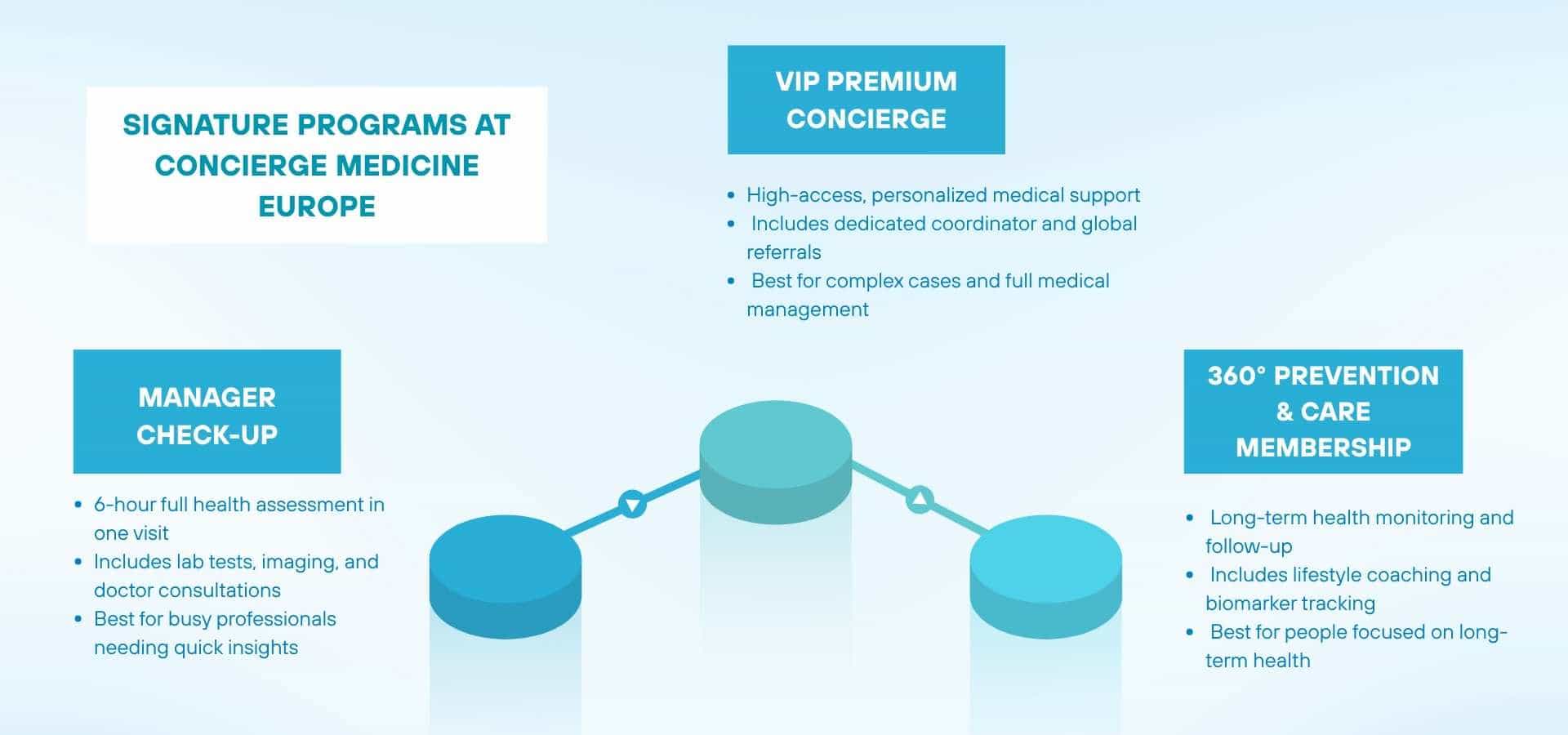
Manager Check-up (Same-Day Program)
|
Category
|
Details
|
|
Duration
|
Approximately 6 hours
|
|
Structure
|
Multi-specialist diagnostic assessment
|
|
Includes
|
Laboratory testing, imaging, physician consultations
|
|
Output
|
Consolidated report with physician interpretation
|
|
Use Case
|
Time-constrained executives seeking baseline assessment
|
This program combines multiple disciplines into one session, reducing the need for repeated visits.
360° Prevention & Care Membership (Ongoing Program)
|
Category
|
Details
|
|
Duration
|
Long-term membership
|
|
Structure
|
Continuous monitoring and follow-up
|
|
Includes
|
Lifestyle medicine coaching, biomarker tracking
|
|
Output
|
Longitudinal health tracking and periodic reviews
|
|
Use Case
|
Individuals seeking structured, ongoing oversight
|
This program focuses on tracking changes over time, rather than single-point diagnostics.
VIP Premium Concierge (Extended Access Model)
|
Category
|
Details
|
|
Duration
|
Ongoing membership
|
|
Structure
|
High-access, coordinated care
|
|
Includes
|
Dedicated coordinator, global referrals
|
|
Output
|
Managed healthcare navigation
|
|
Use Case
|
Individuals requiring high-touch medical coordination
|
This model emphasizes access and coordination, particularly for complex or multi-system cases.
The clinic integrates diagnostics with supportive medical and rehabilitative services, delivered within a controlled clinical environment.
Medical & Restorative Therapies
Services include:
- Physiotherapy and movement rehabilitation
- Preventive cardiology assessments
- Dermatological screening (AI-supported)
- Allergy and immunology services
- Sleep diagnostics and evaluation
These services are delivered as part of a coordinated system, not as standalone interventions.
Clinical Facilities
The clinic is equipped with:
- 3D echocardiography systems
- CPET (VO2 max testing equipment)
- In-house laboratory diagnostics
- Sleep lab facilities
- Imaging and ultrasound systems
This infrastructure supports multi-system evaluation within a single location, reducing the need for external referrals.
Architecture, Environment & Digital Discipline
The clinic is located in the Parkview building in Prague, designed as a modern, urban medical facility.
Key characteristics include:
- Structured, efficiency-focused layout
- Private consultation spaces
- Minimal non-clinical distractions
Unlike retreat-style environments, CME prioritizes clinical workflow and time efficiency.
Patients typically:
- Visit for structured sessions
- Return to work or travel schedules
- Avoid extended stays
This model aligns with the needs of high-performing individuals managing limited time.
CME follows a membership-based and program-based pricing structure, depending on the level of access and depth of care required.
Pricing
|
Category
|
Details
|
|
Clinic Positioning
|
Premium concierge medical clinic
|
|
Stay Length
|
Same-day to ongoing membership
|
|
Entry Pricing
|
Not publicly standardized (varies by program)
|
|
What’s Included
|
Diagnostics, physician consultations, reporting
|
|
Additional Costs
|
Advanced tests, specialist referrals
|
|
Program Structure
|
Modular (single visit or membership)
|
|
Clinical Principle
|
Diagnostics-first, physician-led interpretation
|
Pricing is individualized and depends on:
- Diagnostic depth
- Program type
- Level of access required
How Programs Are Structured
Typical flow:
1. Pre-Visit Preparation
- Medical history collection
- Initial screening
2. On-Site Diagnostics
- Multi-system assessment
- Testing and imaging
3. Physician Interpretation
- Review of all data
- Identification of patterns and risks
4. Reporting
- Structured report
- Follow-up recommendations (non-prescriptive)
Length of Stay
- Single-day programs (e.g., 6-hour check-up)
- Ongoing memberships with periodic visits
- No requirement for residential stays
This allows integration into existing work or travel schedules.
Visits to Concierge Medicine Europe are typically short, structured, and integrated into existing schedules, rather than planned as extended stays.
Recommended Length of Stay
- Single-Day Visit:
Suitable for the 6-hour Manager Check-up
- Periodic Visits:
For individuals enrolled in long-term membership programs
There is no requirement for multi-day stays, which supports time efficiency for executives and frequent travellers.
How to Reach the Clinic?
- Nearest Airport: Václav Havel Airport Prague
- Transfer Time: Approximately 25–35 minutes by car
- Transport Options: Taxi, private transfer, ride-hailing services
🔗 Find best flights to Prague
🔗 Find car rentals in Prague
Links provided for travel planning convenience only.
Accommodation & Stay Planning
Concierge Medicine Europe does not operate its own residential facility.
Guests typically stay in:
- Nearby business hotels
- Serviced apartments in central Prague
🔗 Explore nearby hotels & apartments
This allows flexibility and aligns with the clinic’s non-residential, efficiency-focused model.
What to Bring
- Previous medical records (if available)
- List of current medications
- Comfortable clothing for physical assessments
No specialized preparation is typically required unless specified in advance.
What Patients Commonly Report
Based on available testimonials and reported experiences:
- High satisfaction with consultation time
- Clear communication and structured explanations
- Improved understanding of personal health risks
- Positive perception of coordinated care
These observations reflect experience-based feedback, not clinical outcomes.
Media & Professional Recognition
Concierge Medicine Europe has been referenced in:
- Forbes (health technology and longevity discussions)
- Vogue (executive health and lifestyle coverage)
- Expats.cz (healthcare system transformation in Czech Republic)
These mentions indicate growing visibility, though they do not constitute clinical validation.
Concierge Medicine Europe represents a structured shift toward preventive, physician-led healthcare delivery, particularly suited for individuals operating under sustained performance demands.
Its model is built around time efficiency, diagnostic depth, and continuity of care, rather than episodic treatment. The integration of multiple specialists within a single system reduces fragmentation, while extended consultation times allow for deeper clinical interpretation.
However, it is important to recognize the broader limitations of the longevity and preventive health sector. While early diagnostics and lifestyle interventions are supported by growing evidence, long-term outcome data particularly in concierge care models remains limited and context-dependent (Rylands, Collins and Collins, 2025; Leive, David and Candon, 2023).
CME does not attempt to resolve these uncertainties through claims or promises. Instead, it offers a structured environment for understanding risk, monitoring change, and supporting informed decision-making over time.
For executives, this model may be less about treatment and more about clarity, timing, and control over long-term health variables.
Is this a medical clinic or a wellness centre?
Concierge Medicine Europe is a physician-led medical clinic, not a wellness or spa facility. It focuses on diagnostics, prevention, and structured medical oversight.
Who is this clinic designed for?
It is designed for:
- Executives
- Founders
- Investors
- Professional athletes
- High-performing individuals seeking structured health insight
How personalized are the programs?
Programs are structured based on:
- Diagnostic findings
- Medical history
- Lifestyle factors
However, all planning remains physician-guided and evidence-aware, without guaranteed outcomes.
How is privacy handled?
The clinic maintains:
- Limited patient panels
- Direct physician access
- Controlled information flow
This supports a high level of confidentiality.
Can I stay connected to work during visits?
Yes. Programs are designed to be time-efficient, allowing individuals to integrate visits into work schedules.
Does the clinic treat chronic conditions like diabetes?
The clinic focuses on:
- Risk identification
- Monitoring
- Lifestyle-based management support
It does not replace specialist treatment or provide emergency care.
How should I evaluate value vs cost?
Value is typically assessed based on:
- Time efficiency
- Depth of diagnostics
- Continuity of care
However, cost-effectiveness depends on individual priorities and healthcare needs.
In high-performance environments, health is often managed reactively addressed only when problems become visible. Concierge Medicine Europe introduces a different model: one that focuses on structured observation, early signals, and long-term planning.
This approach does not promise outcomes. It does not attempt to eliminate uncertainty. Instead, it provides a framework for understanding risk and responding earlier, with greater clarity.
For individuals managing complex responsibilities, this can shift healthcare from disruption to integration from interruption to alignment with performance goals.
The value lies not in immediate results, but in better-informed decisions over time.
👉 View Longevity Program
↩ Return to ExtendMy.Life
↑ Back to Top
Disclaimer
This content is provided for informational and editorial purposes only. It is not intended as medical advice, diagnosis, or treatment recommendation.
No doctor–patient relationship is established through this content. Any diagnostic methods, technologies, or clinical approaches described are presented for informational understanding only. Health outcomes cannot be guaranteed. Diagnostic findings indicate risk patterns and probabilities, not certainty. Individual results vary based on genetics, lifestyle, adherence, and other factors. All medical decisions should be made in consultation with a qualified, licensed physician who has full access to your personal medical history. This content does not replace professional medical consultation and should not be used as a basis for making health-related decisions.
References
Alhawshani, S. and Khan, S. (2024) ‘A literature review on the impact of concierge medicine services on individual healthcare’, Journal of Family Medicine and Primary Care, 13(6), pp. 2183–2186.
Leive, A., David, G. and Candon, M. (2023) ‘On resource allocation in health care: The case of concierge medicine’, Journal of Health Economics, 90, 102776.
OECD (2026) Health: Achieving people-centred, high-performing and resilient health systems.
Rylands, K.S., Collins, C.M. and Collins Jr, D.R. (2025) ‘Maximizing the value of concierge medicine: A systematic review of cost, access, and outcomes’, The American Journal of Medicine, 138(9), pp. 1201–1213.
Li, Y., Pan, A., Wang, D.D., Liu, X., Dhana, K., Franco, O.H., Kaptoge, S., Di Angelantonio, E., Stampfer, M., Willett, W.C. and Hu, F.B. (2018) ‘Impact of healthy lifestyle factors on life expectancies in the US population’, Circulation, 138(4), pp. 345–355.